


The last name I expected to be scribbling into my notebook in Iquitos — the largest metropolis in the Peruvian Amazon — was Gustave Eiffel. Yet here I am, perched on the balcony of La Casa de Fierro (literally ‘the Iron House’) which, as the widely disputed legend goes, was designed by none other than the architect behind Paris’s iconic tower. Whether or not Eiffel truly had a hand in it, Iquitos’s remote rainforest location — reachable only by boat or plane — makes the feat of transporting it here from France in the late 19th century remarkable in itself.
Originally a private residence for a rubber baron, the Casa has been reimagined as a restaurant. I sit with a plate of grilled paiche — a freshwater fish that can grow up to three metres in length and is a local staple. Tuk-tuks buzz around the square below like bees around a hive, and a flock of pigeons swoops down as a chef in whites from a neighbouring café scatters leftover crumbs from the day’s bake.
The pigeon may prove to be the most ubiquitous wildlife I encounter over the coming days, before boarding a luxury riverboat for a four-night voyage down the Amazon and its tributaries. It’s a journey steeped in folklore — this region famously served as the setting for Werner Herzog’s Fitzcarraldo, a fever dream of a film inspired by true events, in which a man attempts to haul a steamship over the Andes in pursuit of his operatic dreams.

My journey through Peru has spanned the country’s strikingly diverse landscapes. Just the day before, I had been in the Sacred Valley of the Incas — on the road to Machu Picchu — over 2,000 metres up; breathing thin, crisp air and staying at Sol y Luna, an art-filled hideaway amid wildflower gardens and Andean peaks. Nearly all roads in Peru lead to Lima, the vibrant capital, which warrants a stop if only to sample its cuisine; after all, it’s home to four of the world’s best restaurants. I had spent the night in Hotel B, a restored Belle Époque mansion in bohemian district Barranco, offers Pacific Ocean views from its terrace. Now, I was deep in the humid, emerald embrace of the Amazon, just 100 metres above sea level.
Night has fallen by the time we take a skiff from the town of Nauta to the riverboat Nera, which is moored on the Marañón River, casting ripples of light across the water. Three decks tall — long, narrow, and barge-like in design — the Nera is painted black to dissolve into the surroundings. As we approach, we’re greeted by the serenade of live Peruvian chicha from musicians on deck.
Inside, the ship feels deceptively spacious yet homey, its detail-oriented design evident down to the brown leather wrapping the sculptural cantilever staircase handrail. Traditional ornaments and antiques — such as ceramic Pucará bulls, typically placed on rooftops for good luck — sit alongside a games room with a pool table and a cosy film snug. Interiors play with light and dark: rich stained-wood panelling contrasts with neutral furnishings, punctuated by cushions embroidered with lively jungle prints. Bathrooms in the 20 suites are tiled in black-and-gold mosaics that echo the intricate Kené patterns of the native Shipibo communities.
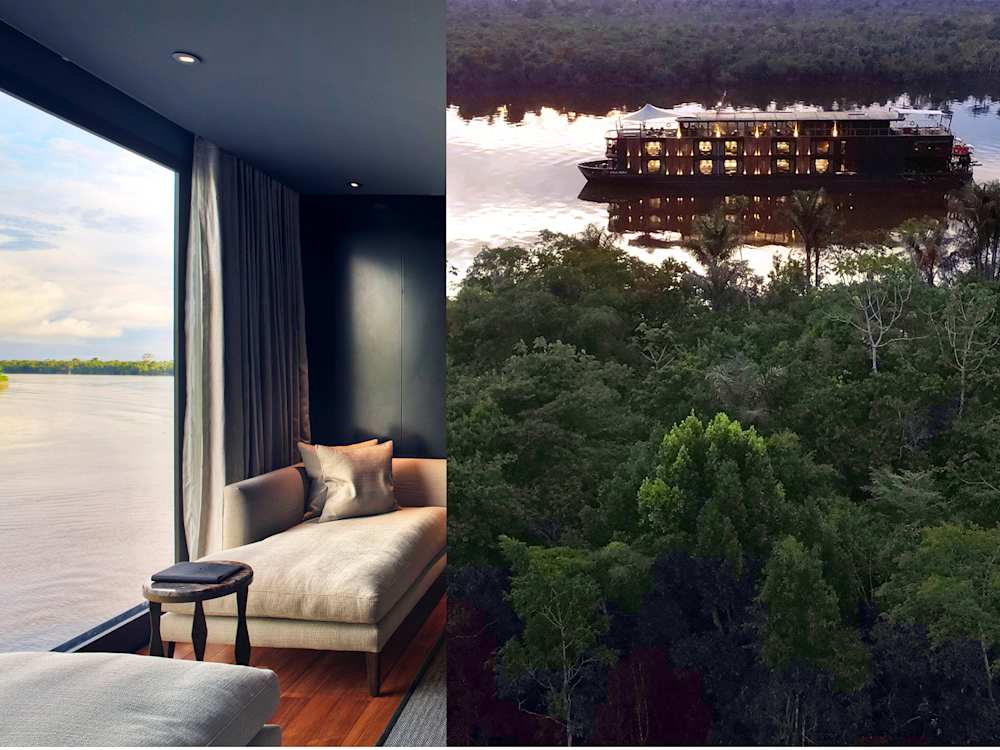
The following morning, I wake in a king-size bed, grateful to have left the curtains ajar — the rainforest glides silently past the floor-to-ceiling panoramic windows. But there’s no time for lazing around; it’s back aboard one of Nera’s skiffs for a sunrise expedition down a narrow tributary. We almost immediately encounter what I’d hoped to see — a pod of pink Amazon River dolphins. As they hunt for fish, they pass playfully beneath the skiff, blowing bubbles against the steel hull.
Squirrel monkeys scamper along the shore, pausing as if to pose, only to vanish before your finger reaches the shutter. As the naturalists remind us, this isn’t a zoo — it’s a place to experience in the moment, not through a screen.
Peru is regarded as one of the world’s best birdwatching destinations, with over 1,800 species — more than 140 that aren’t found anywhere else. Our hawk-eyed naturalist guide, Aldo, points out a horned screamer, vaguely reminiscent of a turkey; a pileated woodpecker sporting a punkish red headdress; a wattled jacana, nicknamed the ‘Jesus bird’ for its ability to walk on floating foliage; and the turquoise-faced capped heron. Over the following days, we witness an explosion of colour — flashes of yellow, red, and blue — as macaws fly overhead; always in pairs, monogamous birds mated for life.
Breakfast is served most mornings on the rear deck. I return to the table armed with chia pudding, fresh fruit and a tamale — made from ground giant choclo corn, seasoned with ají panca (red pepper), wrapped in banana leaves and steamed. As we sail into the Pacaya-Samiria National Reserve — one of Peru’s largest protected areas — what appear to be wasp nests in the treetops turn out to be sloths. Their glacial movements help them evade predators. On a skiff excursion, crew member Aldo explains that in local villages, men patrol the outskirts when a woman is pregnant to keep sloths away, as they’re seen as a bad omen. ‘People think the child will be lazy,’ he laughs, ‘but sloths only come down once a week to go to the toilet. I’d say that’s efficient.’
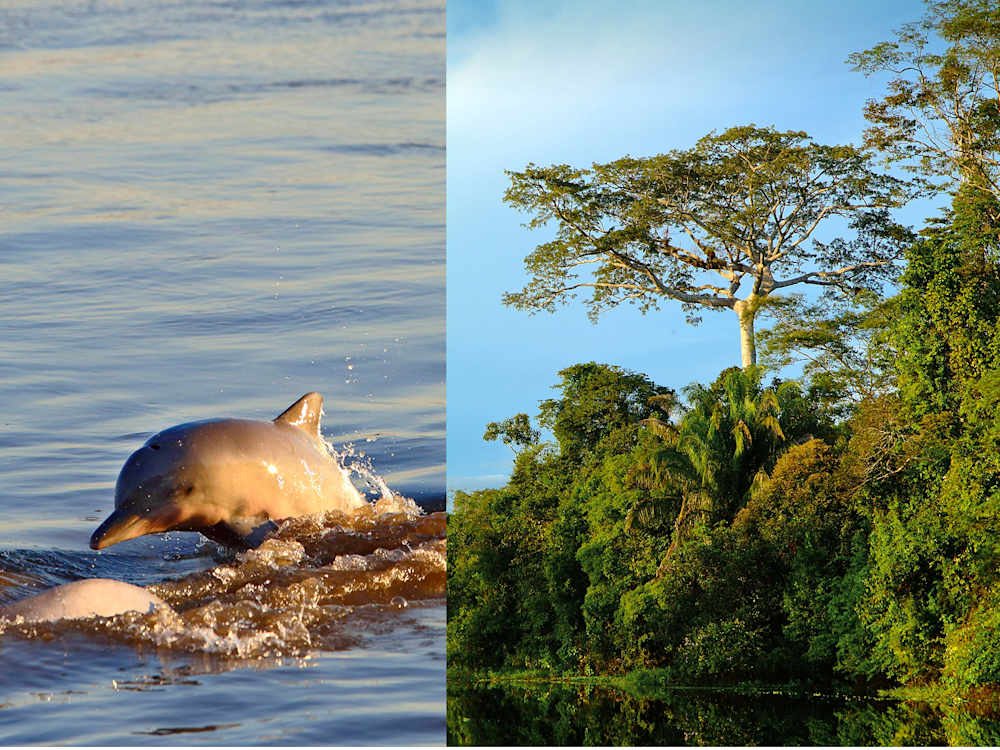
We are welcomed into the communities of the Indigenous Kokama people — custodians of this stretch of the Amazon and its extraordinary biodiversity — as well as the ribeirinhos, the river-dwelling families who have lived along these banks for generations. Many houses sit on stilts to stay dry during the rainy season, when the river can rise more than 10 metres. Fishing is the main livelihood, while baby chickens and ducklings scurry across the floor — the family’s insurance policy should illness or injury keep them from the water. In one home, the matriarch continues a 1,700-year-old tradition of weaving palm fibres into baskets, fishing nets and, now, animal ornaments for visitors — including the hummingbird napkin-holders in the Nera’s restaurant.
Travelling on the Nera is decidedly more active and adventurous than one might expect from a typical cruise. Jungle walks see us rummaging through the undergrowth in search of poison dart frogs and coming face-to-face with an anaconda or a tarantula the size of a frisbee. We kayak and swim in the Yarapa River; its black, tannin-rich waters — I’m assured — are free from piranhas and caimans (an alligator-like reptile).
Back on board, there are masterclasses in making ceviche and pisco sours. From the open-air pool, I watch nature’s theatre unfold on the horizon in the form of dramatic thunder and lightning storms. Dinners might feature chifa — Peruvian-Cantonese fusion fare — or slow-cooked beef shank with tacupi sauce, made from fermented cassava root. Meals are served family-style on plates adorned with serpent motifs in gold leaf representing the Amazon — which we’re told must be washed by hand.
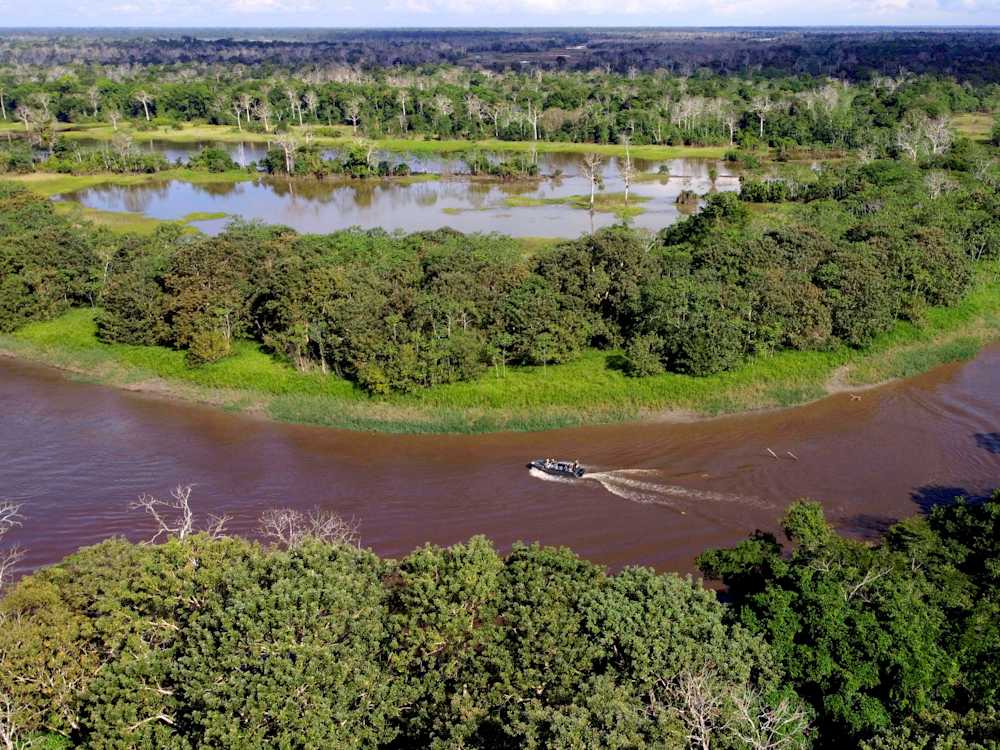
In the evenings, the crew demonstrate their musical prowess in the lounge or take us out on nighttime expeditions into the creeks. At one point, they cut the engines and switch off their torches, and the jungle symphony of bat wings fluttering, insects buzzing, monkeys howling and frogs croaking seems to rise to a crescendo.
On our final day, after disembarkation, we visit Iquitos’s manatee rescue centre, which rehabilitates young manatees orphaned by hunters, along with macaws and marmosets rescued from the illegal pet trade. These threats, coupled with Peru’s high rate of deforestation, make conservation not just important, but essential. Thanks to efforts like these, there is hope that the Amazon’s wild heart — alive and abundant, as we’ve been privileged to witness — will continue to beat with steady force.
See more of our Peru hotels, or get plotting the ultimate South American adventure
Images courtesy of Aqua Expeditions