



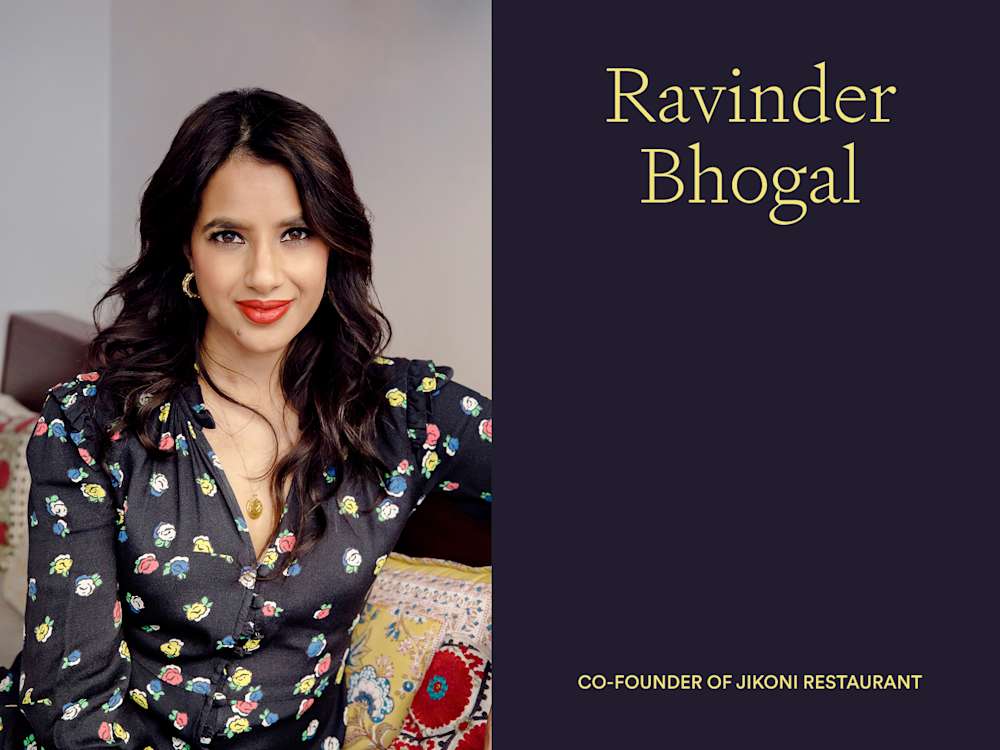
Co-founder of Jikoni restaurant (along with her husband Nadeem Lalani Nanjuwany), writer of many cookbooks, award-winning contributor to the likes of Vogue and The Guardian: Ravinder Bhogal’s life has so far been as flavourful as her restaurant’s signature prawn Scotch egg with banana ketchup. A rich fusion, too, with a Kenyan, Indian and British heritage that informs her bold, dynamic dishes and no-borders approach to dining.
This year Jikoni turns ten, and Bhogal is in characteristically expansive form. Café Jikoni has just opened inside the new V&A East Museum in Stratford: a public institution, a diverse community, and a many-faceted challenge. Later this year, Karam’s arrives at the Brunswick Centre in Bloomsbury: a South Asian vegetarian restaurant named for her grandfather and rooted in the Sikh principle of seva — selfless service through food.
You were born in Nairobi, moved to London at seven, and describe going from lush tropical gardens to a grey, wintry landscape. How did that shape not just the food you cook, but the kind of spaces you want to create?
Arriving in a new country, especially one that has such a different culture and climate, is alienating and disorienting. So I have always tried to create spaces that feel inclusive, pluralistic, kind, nostalgic and comforting — a sanctuary, especially for those for whom home is everywhere and nowhere all at once. I cook across borders because I believe that when we bring cultures together, we create something that is better than the sum of our parts; I suppose this is my politics in food. It also gives me great pleasure when my guests taste something familiar, something that reminds them of home, wherever that may be.
My philosophy is to cook maternal food. Feel-good, life-enhancing dishes that nurture, nourish and lift your mood; food you never, ever get tired of eating; meals that bring equilibrium when the world seems fraught. Importantly, each dish should transmit a bounty of love and warm sentiment. I aspire to cook food that transports the people I am feeding into a soft-focus cocoon, where it feels as though the world exists for nothing but your pleasure — each ingredient deftly cooked and seasoned considerately with something that tastes like love.
You and your husband co-founded Jikoni, have just opened Café Jikoni at V&A East, and will soon open Karam’s in the Brunswick Centre. What does it take to make a creative and commercial partnership work with your life partner?
We remind ourselves, when things get dicey, that being partners in work and life is a great privilege. It allows you to have empathy for one another because the project is a joint one, and you get to spend the most amount of time with the person you love the most. Having compassion for each other and giving each other space is very important. We try and make time to do things together that are outside our sphere of work — travel being one of those great pleasures.
We try hard to trust each other to do things to the best of our ability and especially not to micromanage each other — the cause of most clashes! It’s important to stick to your specific roles and collaborate considerately when you cross over. We do try not to talk about work in our time off, but this is impossible because we are both so passionate about our businesses.
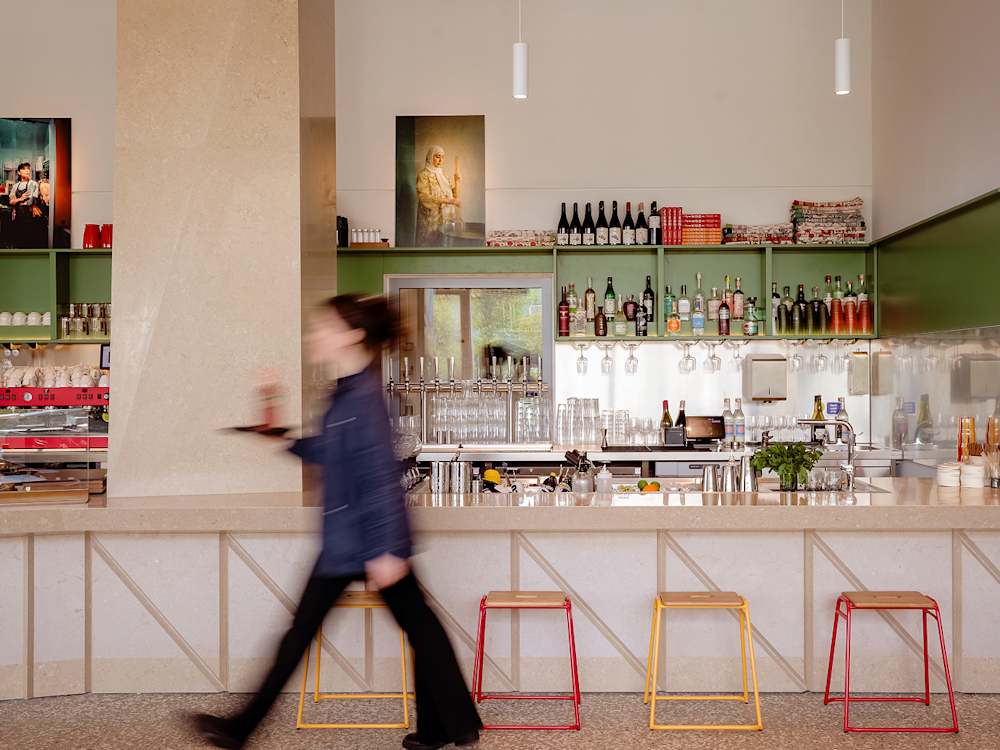
Café Jikoni translates the Marylebone restaurant’s ethos into a major gallery space among the communities of East London. How did you approach honouring your original ambition, especially without compromising what makes Jikoni so special?
For us, restaurants have always been spaces of refuge and restoration. They are spaces in which we hope to restore each other (the team), then our guests, suppliers, stakeholders, community and neighbourhood, and the wider world around us. For us, we want to bring joy always; to be able to magnify that joy into a larger space and a new, diverse community is an exciting opportunity. Our hospitality remains the same — we always focus on what we can give of ourselves to our guests, that doesn’t appear on the check at the end of the meal.
How much did the V&A East’s setting and upcoming exhibitions inspire the menu?
We have always cooked with a no-borders approach. This has transferred seamlessly to East London because we try and create dishes that speak to the depth and breadth of the vibrant and diverse community that forms our neighbourhood. The director of the museum, Gus Casely-Hayford, had a beautiful, hopeful vision of the museum being a civic space that really felt like it belonged to the people who live in the area; a space that felt permeable and open to people of all backgrounds, especially young people. So, affordability is something we really have tried to focus on without compromising on excellent produce.
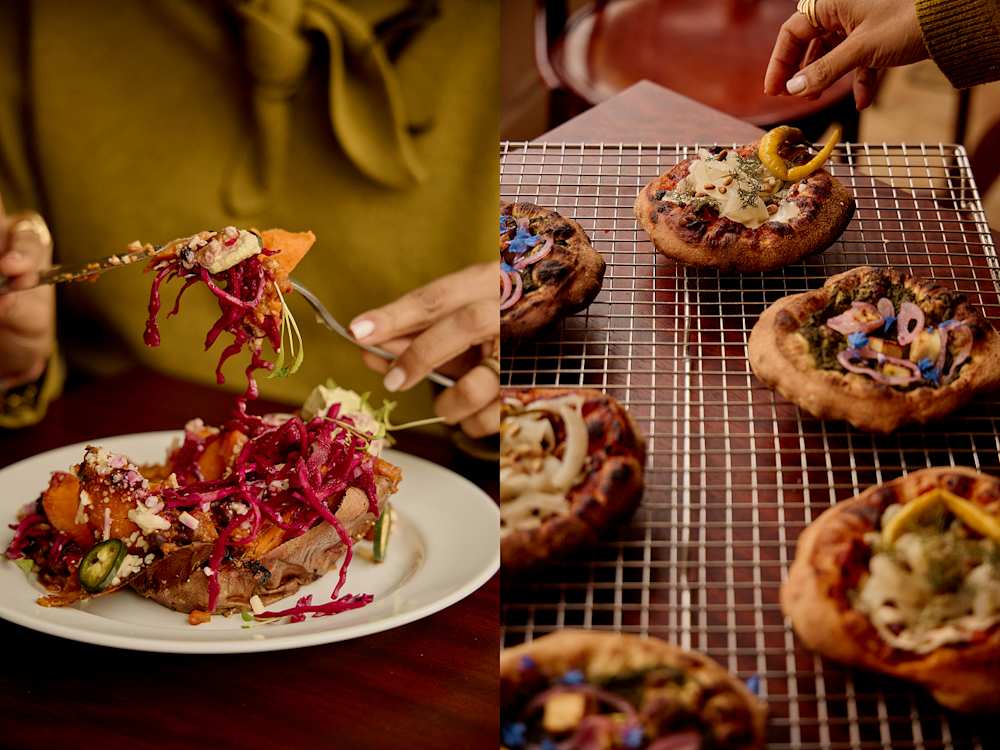
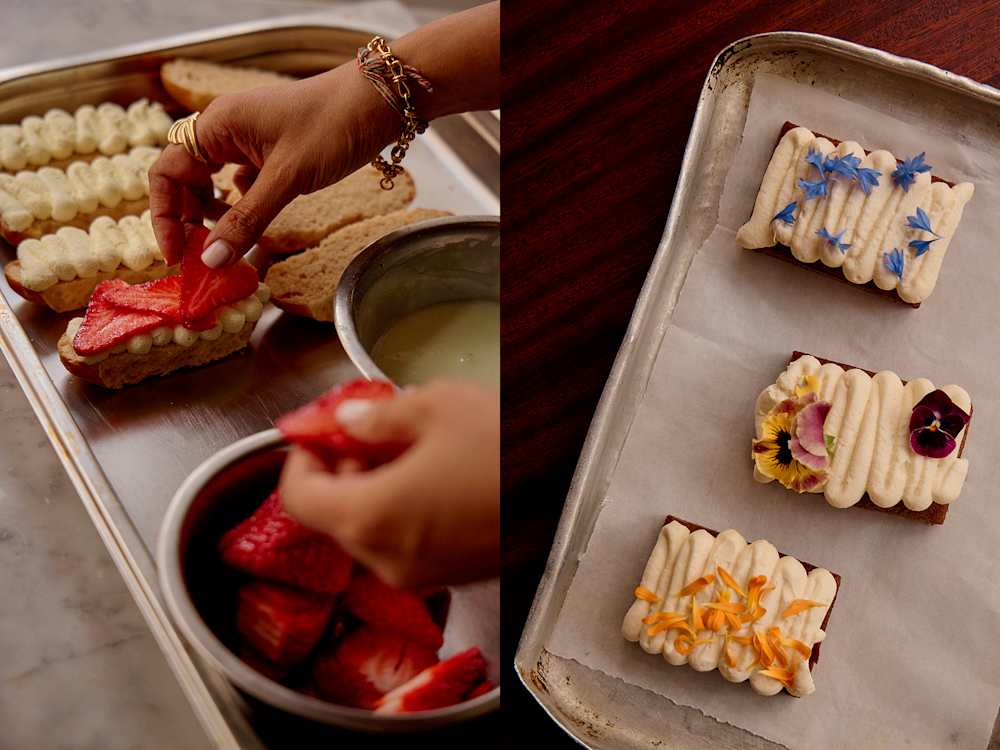
My personal favourites on the menu are the yuzu, pandan and strawberry iced bun; and the turmeric and ginger chicken pie that pays tribute to East London pies but has a filling inspired by a north African b’stilla.
Which other museums and sites do you love visiting?
I recently loved visiting Hauser & Wirth in Somerset for the Don McCullin exhibition, which I found very moving. A few years ago, I also visited their gallery in Menorca, which I loved. Afterwards, my husband and I had lunch in their restaurant Canteen and sat overlooking an incredible Thomas J. Price sculpture. I commented, ‘Imagine having a restaurant in a beautiful gallery or museum and having a view everyday of a piece of art like that.’
It was a moment of manifestation, as Café Jikoni also has a view of a very similar bronze by Thomas J. Price called A Place Beyond. It’s one of my favourite London landmarks because it captures hope.
What does your ideal day out in London look like?
Breakfast, followed by a facial and a massage; lunch, then an exhibition at a great gallery or a good play; and dinner followed by sleep in one of London’s luxury hotels like the Six Senses where I recently stayed. There’s just something about hotel bedsheets.
What are some of your favourite immigrant-run eateries in London?
Apna Panjab in Southall, a small Panjab restaurant run by a couple I really admire. The food is impeccable — I took Jay Rayner who gave them an excellent review for the Financial Times. I’m desperate to eat at ESEA Community Centre in Hackney, a hub for Malaysian, Chinese, Cantonese and Vietnamese communities. I did a photography project with them recently and the food looked incredibly nourishing.
Jikoni was the UK’s first independent restaurant to achieve Carbon Neutral status. How important is sustainable practice to your creative process, and do you think luxury hospitality has a specific responsibility to champion that?
I was born in Kenya and grew up watching communities of rural farmers working extremely hard and living very gently, yet because of climate change, they are the ones who are picking up the tab for our greedy consumption. So it is extremely important for us to be part of the solution, to continue to improve on our carbon output year on year and not add to the problem. We all have a responsibility to be part of a more equitable world, and I think corporate giants especially should be held accountable.
Your last cookbook, Comfort and Joy, was a love letter to vegetarian cooking. Karam’s — named after your grandfather and rooted in the Sikh idea of seva, or selfless service — will take that further. Can you tell us more about the concept and inspiration?
Karam’s is a project that is very close to my heart. It’s an attempt to recapture and preserve the food and flavours that connect us to our South Asian roots and the maternal figures who cooked the food that sustained us. We want our guests to savour the flavours that blossomed in the dexterous hands of these women — to benefit from the wholesome, healing and nurturing magic of their cooking.
We want to cook vegetarian food that is nutritionally dense and makes us feel nourished. It’s also a way of celebrating my grandfather, who lived up to his great name ‘Karam’, which means ‘generous, honourable and hospitable’. Our plan is to use our purchasing to empower farmers and producers that are invested in the environment and land. Food shouldn’t just taste good, it should do good.
Karam’s was inspired by gurdwara langar (communal dining spaces in Sikh places of worship). Are there any dining traditions from other countries you wish were more commonplace in the UK?
I love the tradition from many parts of the world of communal dining with family, friends and neighbours. Breaking bread with people and sharing what you have is an important way of creating resilience and a sense of community. I especially love the harvest-festival feasting that happens in places like Italy and Greece, and the communal economy of sharing and swapping what you have grown or produced with your neighbours.
You’ve built restaurants, written books, collaborated with institutions from Fortnum & Mason to the V&A, and championed immigrant cuisine at a time when that conversation has never mattered more. What’s left on the bucket list?
To continue to cook food that brings people together, that makes our guests feel happy, to collaborate with cultural events and institutions and to write more. I also want to be able to travel more than ever because this is what inspires both my cooking and my writing.
Jikoni will turn 10 this year — congratulations! What do you think the next 10 years of the restaurant will look like? Is there a version that could travel?
I think we have got better and better over the years, both in terms of our cooking and hospitality and I would be very happy if we continued that arc. We have always tried to make sure that every pound we spend in our business is doing good, whether that’s through buying green energy, supporting organic and biodynamic vineyards and minority makers, or by raising money for causes related to women and children. As we grow, we have more of a capability to expand this spend and I find contentment and purpose in this.
As for travel, yes please! I have already travelled to countries like India and the Maldives to cook, but I would especially love to partner with a hotel or like-minded partner in Kenya — that would be a homecoming.
What’s the most memorable meal you’ve had on your travels?
A very-early-morning cup of tea on the terrace of my villa at Malabar Hill Hotel; a serene, ocean-facing property perched on high among an emerald tapestry of forest, farmland and paddy fields in Sri Lanka. Waking up to the sound of Buddhist chanting, and the symphony of birdsong rising through the morning mist, made me feel like all the peace in the world had been harvested and contained in this otherworldly estate. The food in their restaurant is also fresh, local and sublime.
Is there anything you can share about your upcoming novel?
Only that I’m trying to find time to work on it between restaurant projects. I have had to put my pen down this year, but I hope to get it finished in 2027.
Discover more innovative talents in our Yes, Chef series and take your tastebuds on a journey with our culinary collection