



At first glance, Argentina’s Misiones Province looks so wild it feels highly unlikely you’ll connect with another human there. It’s dominated by 50 per cent of the country’s biodiversity, and in its bouclé-green expanse of Atlantic rainforest nature reigns, from rare big cats to tropical birds and butterflies adding colour to the treetops; and the odd sloth or capuchin playing above jungle-wrapped trails laid out in Sorel-boot-sludging red clay.
Beyond this are abandoned Jesuit citadels, mine wells jagged with their linings of precious stones, and the crashing convergence of the Paraná and Iguazú rivers, resulting in the famous, furious Iguazú falls. But, there’s actually a great deal of humanity here, most notably the Guaraní tribespeople, who’ve called this rainforest home for millennia (and have a cautiously respectful relationship with the Falls, believing the Devil’s Throat section to have hypnotic powers).
A LODGE WITH A LIGHT TOUCH

Then there’s Awasi Iguazú — the third in a trio of remote luxury lodges, also located in Patagonia and the Atacama — where you won’t just find polished and personalised service (guests are assigned their own knowledgeable guide and a four-wheel-drive vehicle for the duration of their stay), but the best of human nature too, flowing through its eco-friendly initiatives, outreach to local charities and Awasi Artist Immersion programme as forcefully as Iguazú’s insatiable waterworks, a 15-minute drive away. Creature comforts are as present as the, well, creatures: each Nordic-styled stilted lodge amid the trees has a private deck and plunge pool, a spa offers sound healing and meditation to the calls of the wild and the cuisine is far above the bare necessities. But its mission is to truly engage guests and inspire them to be conscious of and caring towards the fragile ecosystem surrounding them
SUSTAINABILITY AND INCLUSION
Any luxury hotel worth its sustainably-sourced salt can throw out the single-use plastics, recycle and remind guests to reuse their towels; and indeed, Awasi does all this as well as being fully carbon neutral, protecting 340 acres of woodland which absorbs more than 10,000 tonnes of CO2 a year (which even covers guests’ travel); interacting sincerely with the Guaraní, sensitively involving guests in walkabouts and rituals, and providing staff roles and training programmes for both them and the special-needs youth of the Instituto Esperanza school; and putting in place conservation efforts to track dwindling species and keep poachers at bay.
AWASI ARTIST IMMERSION PROGRAMME
Art has proved a powerful tool, building on an ancient tradition of Guaraní craftsmanship and music. Being awestruck by nature is the norm here, where all windows frame a David Attenborough documentary; but art installations serve as a way to honour the land, bringing it indoors in surprising, attention-grabbing ways. Awasi’s Artist Immersion programme added a unique element of conscientious creativity to the lodge, where those invited on residencies get — often viscerally — stuck into the surroundings and leave a lasting imprint with a gentle footprint.
As part of the programme, Misiones native and graphic designer Andrés Paredes used foam and debris from the Yasy waterfall to paint watercolour abstracts of metamorphosing insects; and connected with community basketweavers to craft the installation Plot and Denouement. These woven vessels tied to a tree will shelter wildlife then biodegrade out of existence. As Paredes says, ‘This is where the artwork truly begins’.
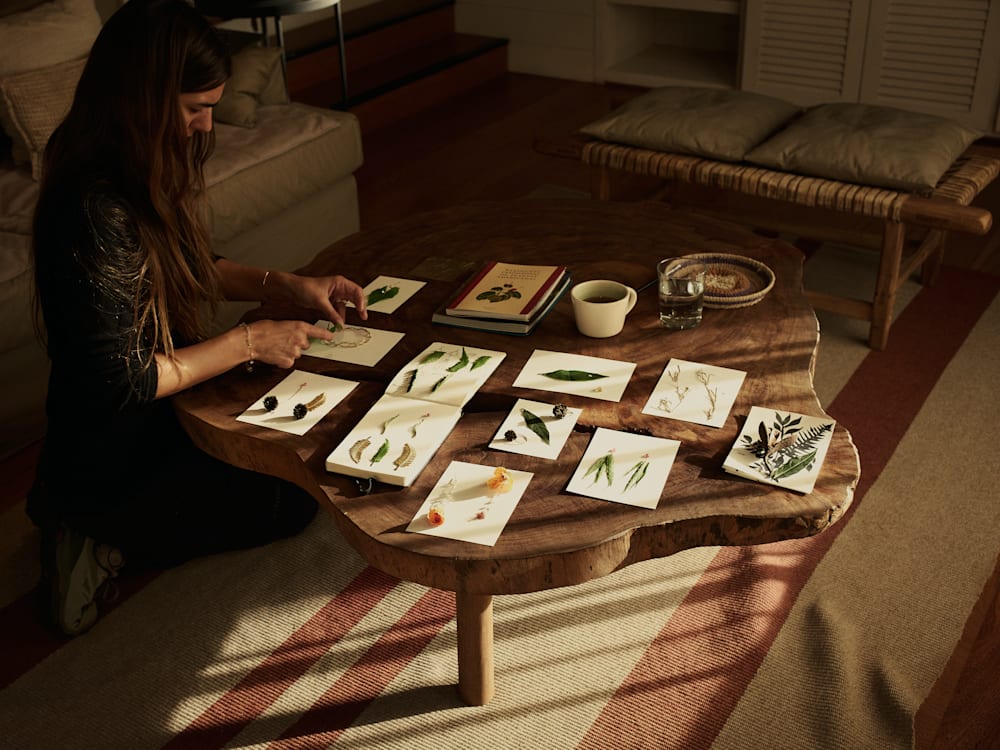
Architect and ceramicist Felipe Assadi and Catalina Zarhi combed the undergrowth for fallen branches to use for their Confluencia sculpture, binding them with cotton ropes to represent the constant flow in the void of the river basin, ‘blending poetry with fragility’. While Angela Bulich, biologist and jewellery designer for Leather Stone Metal, gathered fallen flowers, loose ferns and dried bamboo to create a collection Awasi guests could buy as a non-invasive reminder of their own immersion in the greenery.
There’s always a new fascination to be found in the outdoors, so Awasi’s roster of artists keeps stacking up, with photographers, noted painters, scent-makers, textile artists, sound designers and more set to interpret the jungle in bold new ways.
LEARNING LOCAL CRAFTSMANSHIP
Sculptors and ceramicists have found fine form in the ochre-hued Ñaú river mud too, a crafting material used for millennia. On Gabriela Ezcurra’s explorations of the Guaraní’s Yryapu reserve (a five-minute walk from the hotel), she was inspired by ‘life sprouting from decomposing trunks and mushrooms emerging like magical beings’, and crafted Living Soil, a sculpture of a fungi-studded trunk made using raw, un-fired clay with seeds and roots left within so that they might continue to grow. While porcelain sculptor Florencia Echeverría learnt authentic weaving skills to work into and expand on her practice.
CONNECTING WITH THE COMMUNITY

Some residencies weave themselves into the fabric of local life. Juilliard-trained dancer Teresa Marcaida’s A Peculiar Quietness is a short film of her moving lyrically over a parched riverbank, waterfall-sprayed rocky outcrops and through a sunken forest; but her movement sessions for local special-needs students’ helped their physical and emotional education. And tribespeople were invited by photographer Ingrid Weyland to apply finishing touches to her large-scale Topographies of Fragility landscape prints, layering them with crumpled duplicates to highlight how easily the rainforest could degrade.
Building on Awasi’s free arts and drama programme for indigenous children, held at the Yasy Porá school, visual artist Eugenia Soma and cookbook illustrator Josefina Jolly held sketching classes covering myth, food, community, flora and fauna, to empower their sense of cultural identity. Or some take an even more hands-on approach: Paulistan tattoo artists Stella Nanni and her son Gabriel — whose Tattoo Truck Tour project has provided free scar cover-ups for breast-cancer survivors throughout Brazil — parked up at Awasi to design tattoos to conceal surgery and burn scars for native women, using floral motifs that bring a ‘certain peace and spirituality’.
And, more recently, Brazilian photographer and poet Fabiano Al Makul and New York painter Rainer Gross, made a connection through music, one playing the cavaquinho (a ukulele-style instrument), another reed flutes, alongside creating nature-inspired art.
CONSIDERED CONSERVATION
Animal well-being is a concern too. The rainforest only covers 10 per cent of the land it once occupied, and a number of endemic species have died out with their habitats. Awasi supports the work of conservation and rehabilitation centres Güirá Oga and Aves Argentinas, who are reintroducing harpy eagles, white-lipped peccaries and more species into the wild.
Biologist and paper artist Josefina Stagnaro was so inspired by its Maracaná Project, which sees the release of blue-winged macaws back into the forest, that she perched emblematic effigies made from strips of paper in tree branches surrounding the property. You too can find solace in the choir of the forest canopy, venturing out with blind nature recordist and sound designer Juan Pablo Culasso, who can identify more than 8,000 bird calls, and implores guests to take a deep breath and sit silently to muse on the world’s wonders. Or simply tune into one of the conservation talks frequently held on-site.
This kind of slow, soul-stirring contemplation is heavily encouraged at Awasi, whether you just watch the world crawl by; learn Guaraní legends at a leisurely pace — such as how Iguazú Falls came to be (no spoilers, but it involves star-crossed lovers and a demonic river goddess) — spot monkeys over Malbec; or go full-throttle adventuring. There’s no need to plant a tree; just go lightly, listen for your own creative call of the wild and heed the nature-nurturing lessons threaded into the works artists have left on display at the hotel, so you can carry them forward after check-out.
Read more about Awasi Iguazú or see our most sustainable stays