



When looking for a winter-sun escape from the dark depths of January, it wasn’t a difficult decision to heed the irresistible siren call coming from those droplets of cyan ink in the Indian Ocean, also known as the Maldives. And so, for the first holiday à deux for my husband and me since our honeymoon, we are happily heading to that Platonic ideal of island paradise.
But choosing where to stay is rather more complicated. We aren’t honeymooners, so we don’t want the amorous seclusion that would suit a couple intent on doing very little, very privately. Before children, if you can believe it, I had actual adventures on holiday. I skied down mountains and hiked up them; I galloped along beaches on horseback and swam with sharks. Travel used to be the perfect opportunity to launch myself into something new with no fear of looking foolish, and no long-term commitment required.
Lately, though, ‘extreme’ has come to mean handling two tantrums at once, and my rushes of adrenalin come from trying to locate tiny shoes while running 20 minutes late for school. So, for this rare week, with only ourselves to consider, I want more than just a beautiful place to lie down. I want somewhere with a pulse. I want Niyama Private Islands Maldives.
Niyama caters to only-have-eyes-for-you honeymooners, certainly, but if you never leave your villa, you’re missing the point. Because as well as the Maldivian hallmarks of overwater villas and pristine beaches, it has the unique bragging rights of being the only luxury resort in the Maldives with its very own surf break.
I have never surfed before. In fact, my entire knowledge of the sport is limited to the tans, bods and board shorts in the film Blue Crush. It seems like a sport reserved for bronzer, braver people. But where better to learn than in a gorgeous hotel with its very own surf school surrounded by bath-warm water? There are no wetsuits, scary sharks, or other surfers to worry about. We booked Niyama immediately, and I (rashly) swore to my husband that I would stand up on a surfboard before the week was through.
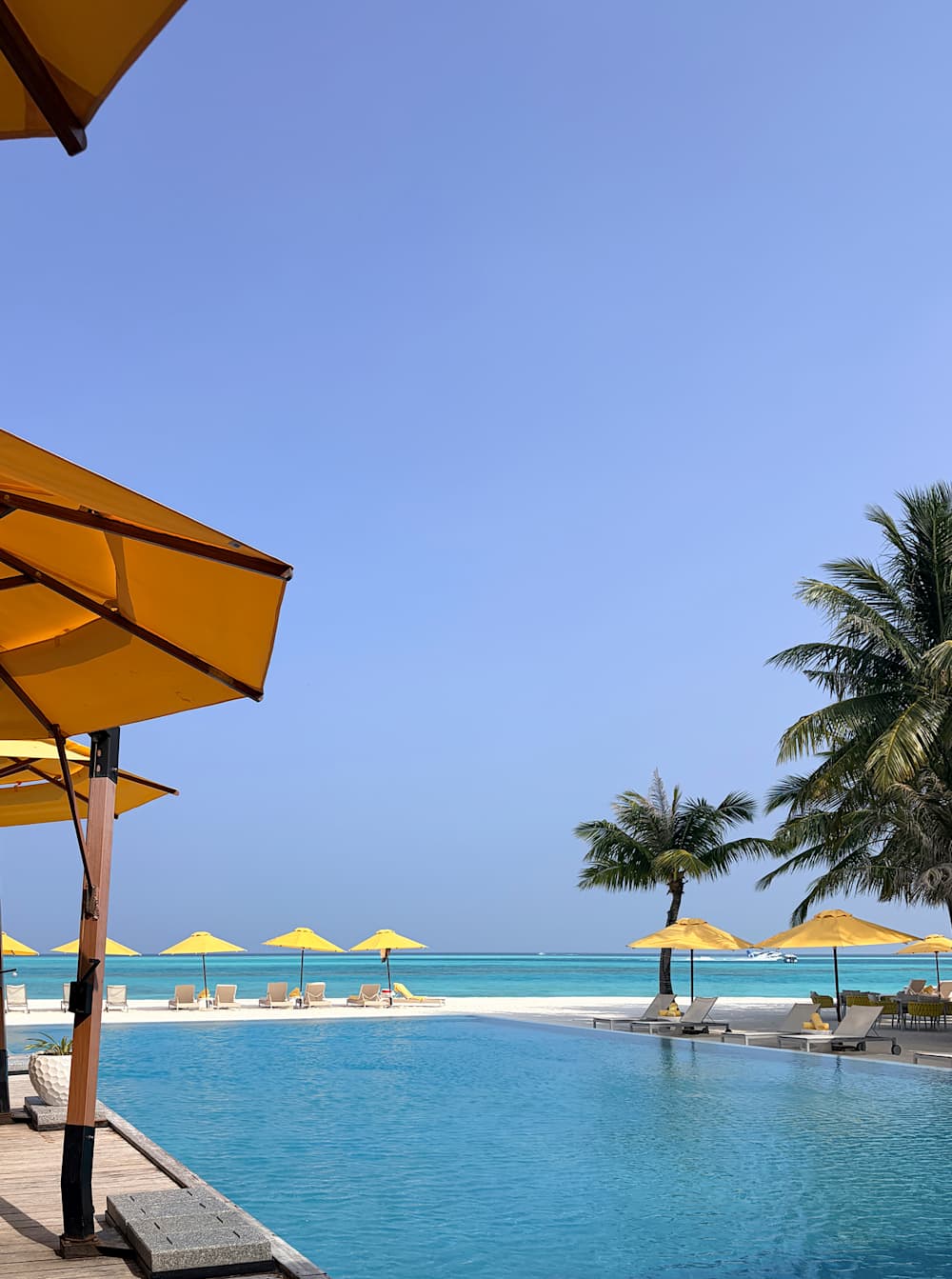
To reach the private atoll, we take a spectacular 45-minute seaplane journey from Malé. The time slips away as our eyes swivel at the sight of the tiny islands below us, scrawled like hieroglyphics in the sea. When we land at Niyama’s jetty, we are greeted by our personal thakuru (butler), Imthy, and delivered to our divine overwater villa. At the touch of a remote-control button, the curtains open and our eyes are filled with the striated view of sea and sky; a blue Curaçao cocktail I want to sip with a straw.
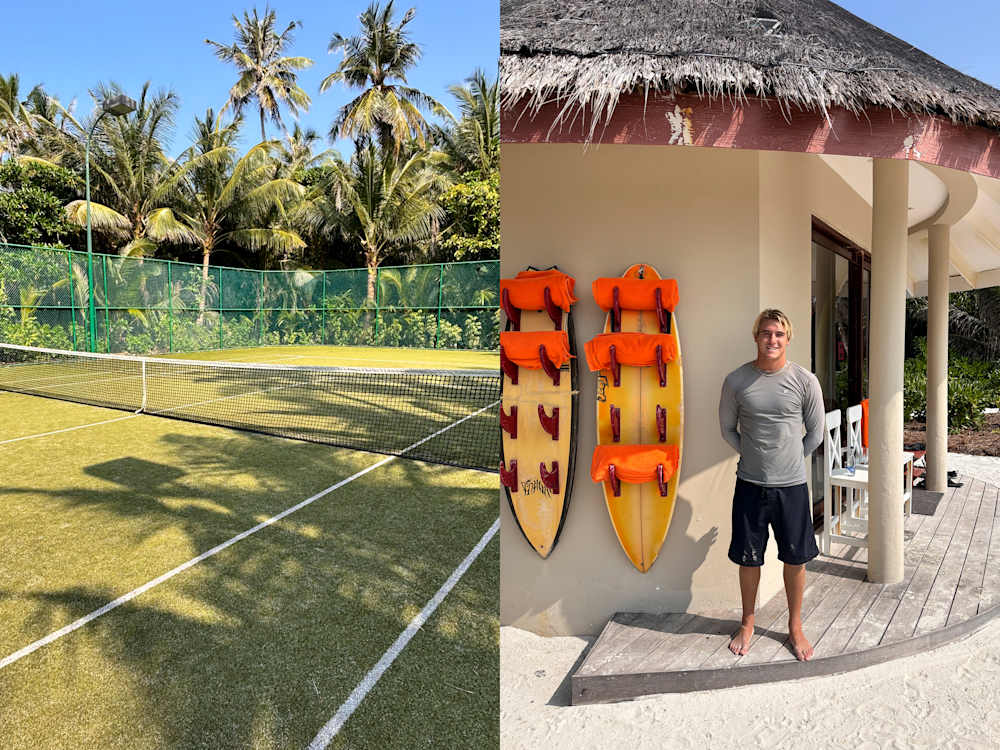
We ease ourselves into island life with morning snorkels, and tennis lessons with pro Patrick on the jungle-encased court. Our scuba-diving excursion is so indulgent, we never touch our own equipment — towels, water and staff appearing at every moment of need.
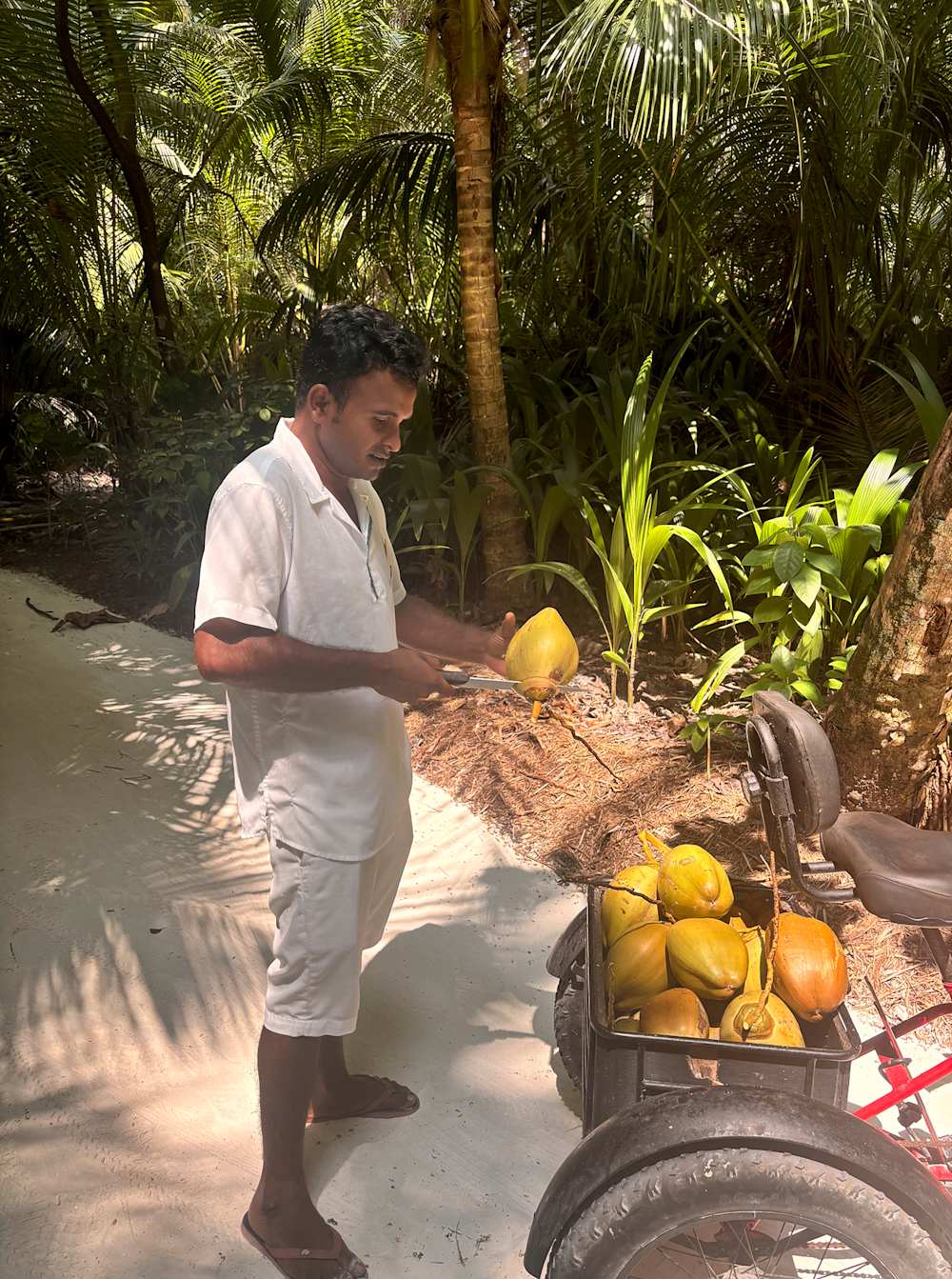
Our commute is by bicycle, pedalling along Niyama’s soft, sandy paths, lanterns glowing at night. The enormous swooping bats, as big as seagulls, add to the otherworldly wonder of the place. And, occasionally, we encounter the coconut man, who materialises just as thirst strikes, hacking open a fresh coconut with his machete and inserting a (biodegradable) straw. Miraculously, he still had all 10 fingers. We checked.
But all this is preamble. It’s time to pedal to the tip of the island for our first surfing lesson, and to meet Cayle (‘Like the lettuce’), Niyama’s resident surf instructor. Before we start, Cayle tells us that his parents run a surfing school outside Sydney, so moulding newbies into stern surfer stuff is his actual family business. We couldn’t be in better hands.
Vodi, Niyama’s powerful, left-breaking wave, is not for beginners, but something about us strikes Cayle as competent, so he decides we can skip the more sheltered baby waves and go straight in. The cresting peaks look enormous to me, but Cayle’s confidence is infectious, so my husband and I follow him into the water.
One at a time, Cayle calls us forward, identifies the perfect wave, and tells us when to paddle. In the excitement and the rush of being propelled forward, I forget everything I learned on the sand, rush to stand up and fall spectacularly backwards. This happens a lot. ‘You gotta get out of your head,’ Cayle tells me. ‘Just slow it down. I can see you overthinking it from here! You think you’re going to fail, so you do. You just gotta believe in yourself. Relax. Trust the process and be present.’ I nod, refraining from telling him that this advice is actually remarkably applicable to most of my life. Then I hop back on the board and paddle out again.
In that moment, I decide that it doesn’t matter one bit if I can’t master surfing straight away. I can just enjoy the improbable fact that I’m here in this water at all and not at home emptying the dishwasher — just having the chance to try is enough. Surfing isn’t something I can intellectualise, anyway. I just need to put one foot up and then the other, bend my knees, and breathe.
The next time Cayle calls me up to take a wave, I try to banish all thoughts of failure. Paddle, right foot, left foot, look up at the beach instead of down at the water. And, for three glorious seconds, I stand up. My board is one with the wave and I am being pushed effortlessly towards the shore. Then I fall off, of course. But it doesn’t matter, because I’ve done it. Cayle whoops like I’m Anne Marie and I’ve just scored a perfect 10 at Pipe Masters (seriously, watch Blue Crush).
Afterwards, I sit with my husband in the sun at the surf shack, drinking the best tasting beer of my life. My hair is a tangled mess, there’s salt in my eyes, and my legs and arms are burning from the exertion. I understand surfers’ bodies now — the powerful arms from paddling through the enormous breaks; the abs that come from pointing the board where you want it to go. And I think I understand their calm, yogic demeanour. There is something about being tossed about like a wave’s plaything that has a very cleansing effect on the soul. All the nervous chatter in my head has gone completely quiet. Obviously standing up was the best part, but the failing was fun, too. Maybe this is why surfers all have that youthful, twinkly spirit, even into their sixties and seventies.
People say the Maldives is about doing nothing. But that isn’t true for me. It’s a place to reconnect with a part of myself that I thought was lost — to find, joyfully, that I am still a person willing to fall down in the pursuit of adventure. I turn to Cayle. ‘Same time tomorrow?’
Leave the sunlounger behind at more of our adventure-facilitating hotels, or get plotting for this year’s winter sun