



As we approach Prague from Václav Havel airport, there’s a clue that speaks to the city’s forward thrust in the 20 years since I first visited: a billboard advertising Marks & Spencer’s Christmas food. Well, well, well: Western decadence has tightened its grip.
But let’s rewind. We all have that first love of a trip — the one that felt like it blew the world wide open. For me, it was to Prague. My memories might be freeze-framed but, despite Prague’s main attractions being centuries old, it’s a city in fast-forward, and nostalgia does it a disservice. So this anniversary is a good time to look back to see why the city first captured my imagination, and to skip ahead to the present day, to see how it’s kept it all these years later.
PRAGUE THEN

I’m thankful that I am still able to return. Back in 2005, the Iron Curtain had long been felled by the 1989 Velvet Revolution. It was the year I turned 21 and this was my first trip abroad with a boyfriend; Czechia had — more significantly — joined the European Union in 2004, entering a prosperous new era. My Czech boyfriend had told me that during the ‘Normalisation’ period of Soviet rule, leaving or entering the country was extremely hard to do (often illegal). And, while our journey back to the ‘old country’ involved an arduous 20-hour coach trip, it was a privilege to visit freely — ominous apartment ‘blocs’ on the outskirts were a small reminder of the political knife turns of the recent past.
Prague’s nickname of ‘the Magic City’ is apt. Its spell is cast in cobbled squares edged with Baroque finery, nymph-studded buildings lined up like Neapolitan ice-cream stripes, gilded art deco cafés where Surrealists used to linger and monuments fit to Cubist angles, all topped with a castle that sparkles after dark. I loved ferreting around Petřín Hill to find its art-filled cavern and seeking the ghosts of literary greats; and seeing history breathe through notably empty plinths and bullet-hole scars. Always one to be curious, I willingly embraced its myths and legends: a Golem on a rampage in the Jewish Quarter (sure!); the thief’s arm hanging in the Basilica of St James cut off by a statue of Mary come to life (don’t steal, kids!); Princess Wilgefortis growing a beard to escape her wedding (honestly, impressive!).
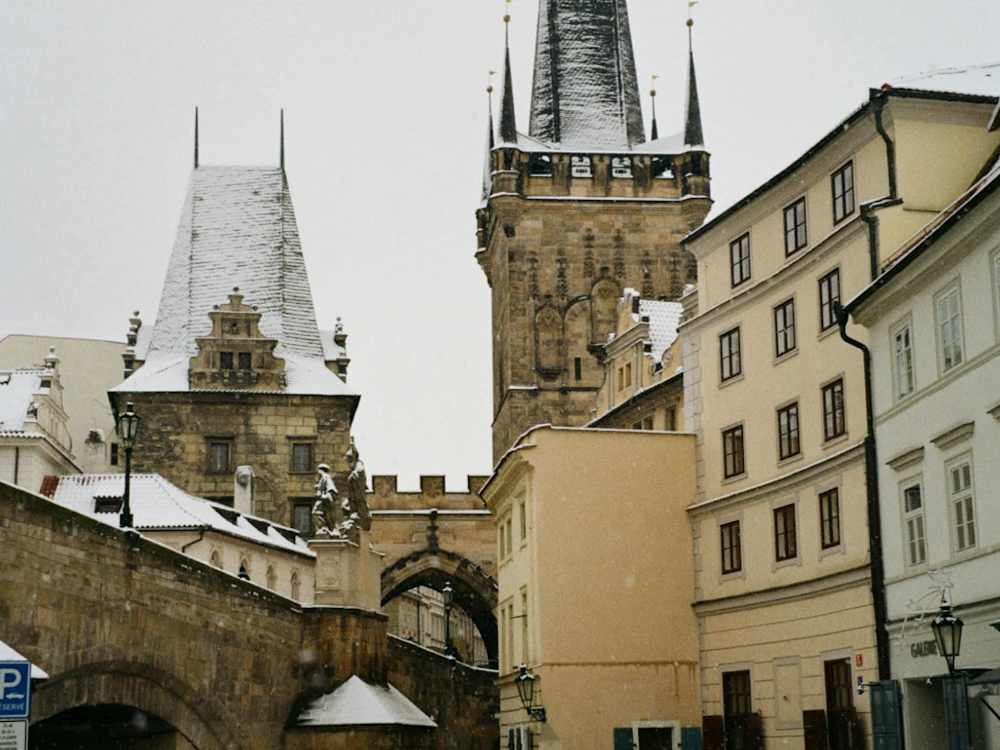
I fell hard — even for its less prepossessing qualities. Say, tripping on potholes and ducking flyaway powerlines; rummaging in shops firmly stuck in the Fifties; flea markets selling furry ushanka hats and Soviet weaponry. The immutable lady, smoking in her underwear in the hallway of the art nouveau apartment we rented. We had a hipster smugness about arriving early to this party, one where the host wasn’t quite ready yet.
Brit stag-dos had cottoned on to the 20p a beer rep (true, if you weren’t expecting Prague’s finest, which was closer to 70p), but otherwise, even during the Christmas-market period, the city was busy yet comfortable. We petted Nativity donkeys with a grog in hand in the Old Town Square, and in the idiocy of young love, watched the sunset on Charles Bridge’s frozen cobbles without getting trampled — a near impossibility now.
There was a sense of optimistic abandon and signs of propulsion — beyond late nights washed away in bottles of Bohemia Sekt (£2.50, if memory serves, although I’m not sure it does), you’d find Frank Gehry’s illusive Dancing House and the Museum of Communism located across the street from a McDonald’s. Artwork had an irreverent edge to it: take David Černý’s faceless babies crawling up and down the Žižkov Television Tower or his figures peeing on an outline of Czechia. The city felt jubilantly unfettered.
PRAGUE NOW
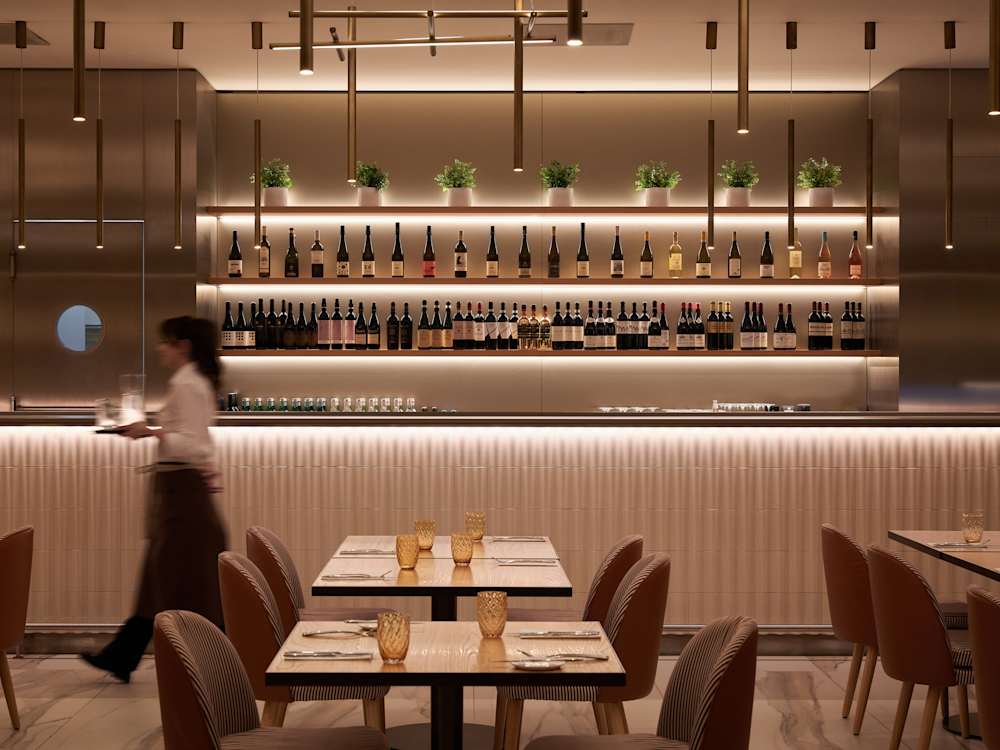
The Julius
It’s 2025, and here’s Colin the Caterpillar. The city’s kept its finger on the ‘update now’ button. The 100-year-old Alcron Hotel where we’re staying (soon to launch on Mr & Mrs Smith) is gleaming after a multi-million-Euro facelift by the Almanac group, and other stays follow suit: The Julius with its modern crashpads designed by Memphis Group co-founder, Mattheo Thun, and BoHo Hotel in an updated deco post office. As someone who’s always felt a little out of time, I’m resistant to these box-fresh looks at first; give me a garret that’s been spun through a few cycles, filled with florid, vintage statement pieces.
But I too have streamlined my life over the years. The boyfriend has long-since been replaced by a husband; my travel-writer job allows me to afford flights over coaches and upgrade my accommodation to these shiny new hangouts; and I’m on a dry kick during our visit. Prague is surprisingly accommodating: Birrell’s non-alcoholic beers — especially the pomelo flavour — save us from water-flavoured nights, and bartenders customise our mocktails without us even needing to ask.
With a clear head, I can fully appreciate the city’s newness: Zaha Hadid Architects’ gold-armoured Masaryčka building; Černý’s huge, silver Lilith sculpture hugging an apartment block in Prague 8; and the city’s first street-food hub, Manifesto, in Prague 5. The thrill of first-time Prague was found in its more antique corners; now I can feel it in lesser-known neighbourhoods, brightened in creative ways — especially Prague 7. The area’s graffitied Holešovice suburb is occupied by a slaughterhouse-turned-arts complex, where galleries and performance spaces lead the creative scene. As we pass cliques from nearby art schools, watch talents at work and stop into co-working space Vnitroblock, I’m hit by that heady wave of longing for the 2010s — that feeling of possibility pulses through here like synth beats.
I find there’s significantly more choice in the everyday, from eateries that have captured social media’s attention to a burgeoning brunch culture and cult bakeries, filling up the millennial bingo card. Venues like Kasárna, where you can watch films alfresco or play beach volleyball (with sand), plus bars with neat gimmicks (in psychoanalysis-themed speakeasy, Anonymous Shrink’s Office we pick our (non-) poisons from Rorschach blots), show the tastes of Praguers becoming more exacting.
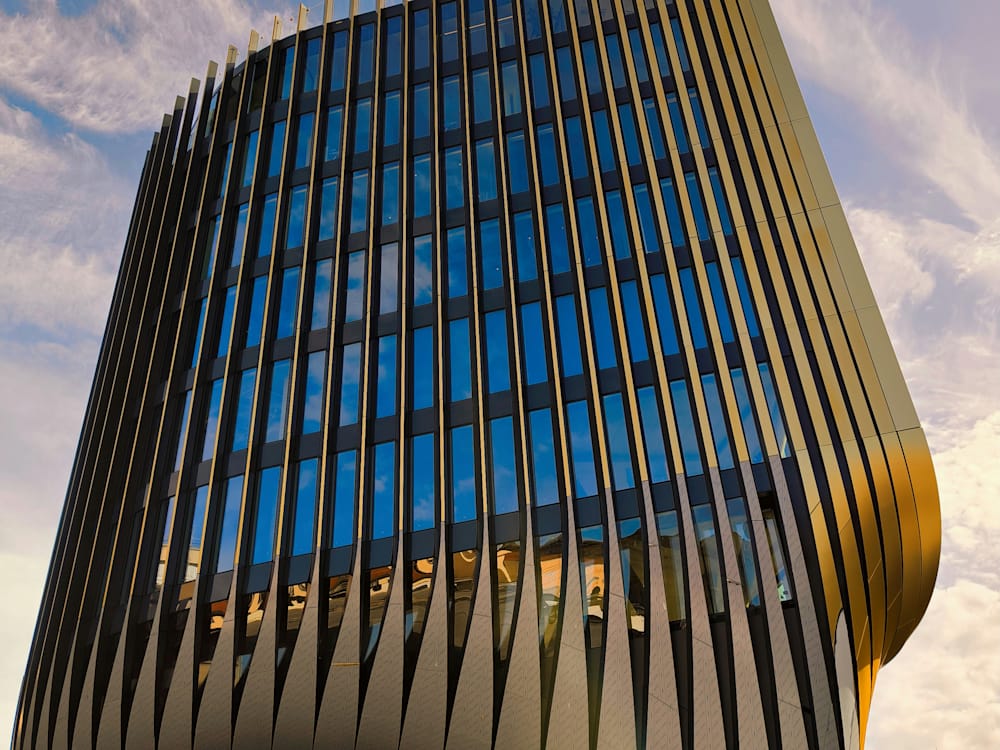
Masaryčka building by Zaha Hadid Architects
The most significant change of the past two decades for me has been to the Czech dining scene. I shudder as I recollect leaden meals comprised of dozens of dumplings, vegetarian ‘options’ of a bowl of sweetcorn or peas, and organ meats that weren’t quite Fergus Henderson trendy. But now, I’d come to Prague just for the food — in 2012, the city won its first Michelin stars (at The Alcron’s own restaurant and Allegro at the Four Seasons Hotel) and tasting menus have become a thing (a tear ekes out as I see prices soar up to €200 per person, wine flight not included).
The Eatery is one such restaurant that makes me excited for the future of eating out here. Head chef Dáša Fejtková’s take is that ‘Prague has opened up to the world in a remarkable way while becoming more confident in its own identity.’ As we tear into a dish of smoked-pork tongue in horseradish foam, I can’t help but agree — the sense of pride is palpable. Impeccably styled bars serving natural and new Moravian wines are gaining popularity too; although, for old time’s sake, I pop into ancient beer hall U Fleků to see if waiters still smash dark, treacly suds down in front of you like you’ve cursed their babi (grandmother). They do, and I wouldn’t have it any other way.
PRAGUE FUTURE
My love for Prague puts me a little at odds with my aim to be a conscientious traveller. I want to see that economic upturn, the city’s emotional core come to full expression and — maybe most importantly — the food to be recognised among Europe’s great gourmet cities (an upcoming Michelin guide of Prague’s own confirms that upward trajectory). But I can’t help reminiscing about not just the now-atrophied strength of the pound against the kroner, but also the thrilling, early-doors chaos, which I miss in a way I’m sure the locals don’t.
I’m content to fall in with the city’s steadier stride — see art galleries and rummage in vintage shops, hunt down Czech glass and ceramics, then wrangle my steak tartare and smoked-veal skewers into an acceptable Insta mise en scène before bed.
Its energy makes me giddy; much like the surrealists beforehand, people are opening the door to dreaming. There’ll always be some intricate stonework still to catch my eye or an on-high aspect I haven’t admired it from yet (I’m excited to try the newly renovated Petřín Hill Funicular when it resumes in 2026). Its cultural reach continues to flourish, too, with Holešovice’s new philharmonic, major art collections growing in size, and on-the-horizon events such as the 2026 Composers’ Summit and 2027 Quadrennial. Why romanticise the past, when there’s so much to love in the now? Kafka once said of his home: ‘Prague won’t let you go, the little mother has claws.’ It certainly still has me hooked.
Ready to start your own Czechia romance? Get to know the city more intimately with our full collection of hotels in Prague